
Lake Wales Chamber Proposes Birth-to-Four Early Childhood Readiness Plan
by James Coulter
To prepare young people with the literacy skills needed for tomorrow’s workforce, several educational initiatives have been proposed by the Lake Wales Chamber of Commerce/Economic Development Council (EDC).
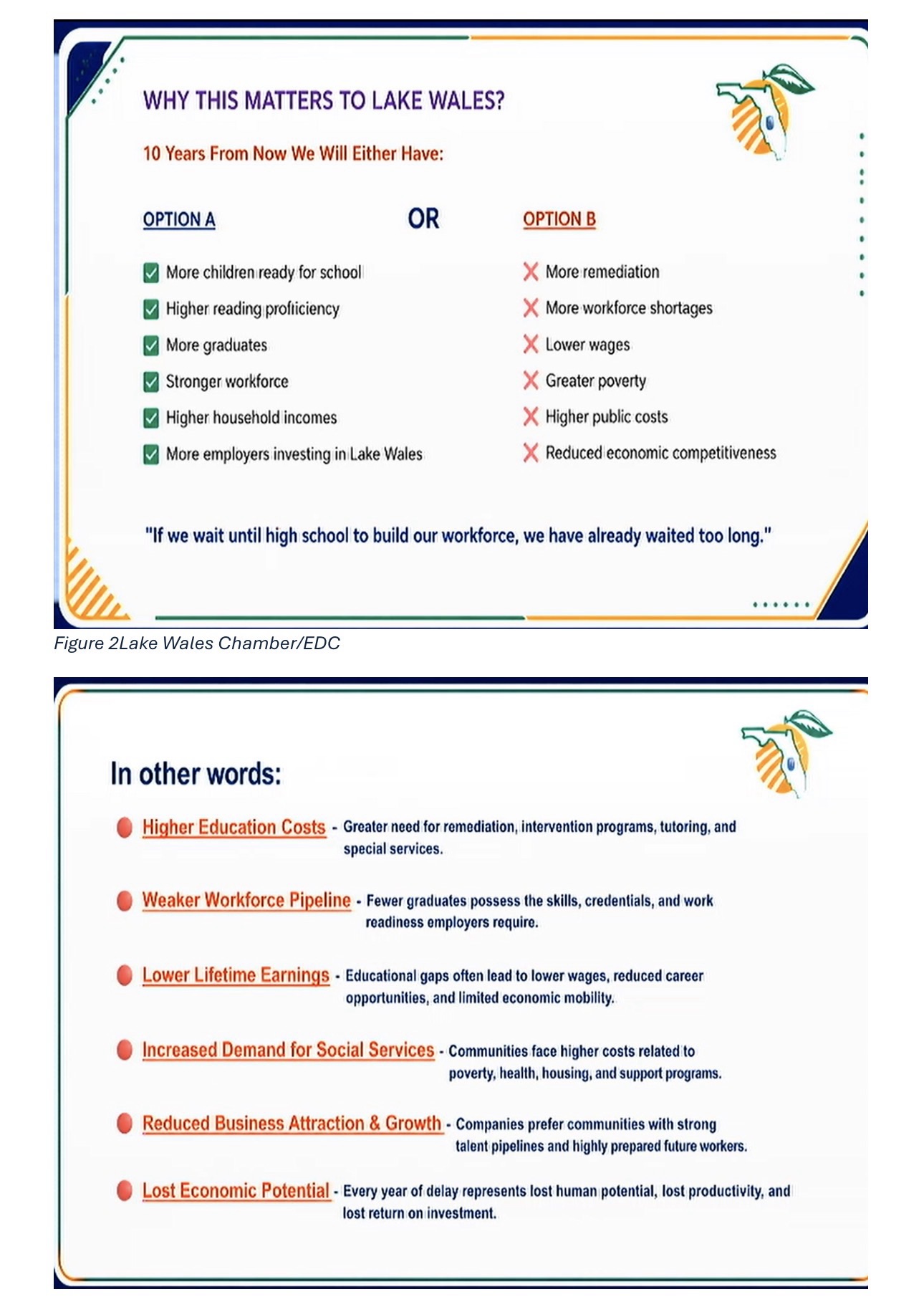
At their recent work session on Wed. July 1, 2026, Lake Wales city commissioners received a presentation from the Lake Wales Chamber/EDC outlining strategies for long‑term economic development, including efforts to cultivate a future workforce for prospective businesses.
Skip Alford, President and CEO of the Lake Wales Chamber/EDC, stressed the need to develop well‑prepared future workers and strong talent pipelines to attract new companies, arguing that potential industry cannot exist without potential employees.
“Just as important as bringing manufacturing and industry jobs to the present downtown, if we neglect our youth, all of that is going to be for nothing because we are setting an entire generation or two up for complete failure,” he said. “Every year of delay represents lost human potential, lost productivity, and lost return on investment.”
Alford outlined several initiatives aimed at preparing young people to become future employers and employees. One initiative was the Lake Wales Highland Moguls, a Lake Wales High School program designed to “develop the next generation of entrepreneurs, innovators, and business leaders through real‑world business experience.” He said the program will mentor and train students interested in entrepreneurship, working with local economics professors to identify and recruit promising candidates.
While high‑school training matters, Alford claimed the greater priority is supporting young children before they even enter kindergarten, describing early childhood development from birth to age four as “the most critical aspect of a child’s education.”
Alford noted that a child has already developed 90 percent of their brain capacity by age five. Because of this, education must begin well before school enrollment, and failing to do so sets children up for failure, he argued.
“If during those first five years, that capacity has been failed, altered, or received no education whatsoever, the kindergarten teachers are going to continue to inherit a human product that is not prepared and not ready,” he said. “We cannot continue to let the children of Lake Wales, even the youngest of the youngest, not have an opportunity to start learning as early as possible so they can have a decent or successful life.”
Commissioner Terri Miller asked how much time had gone into developing the early‑childhood education model. Alford replied that the initiative is now underway and that he will devote 25 to 30 percent of his time to building it. He noted that, because the program aligns with Superintendent Julie Conrad’s strategic vision, he waited for her plan to be approved before proceeding.
Commissioner Carol Gillespie asked why the Chamber, rather than the school board, was leading efforts to expand early‑childhood education. Alford explained that the school system does not serve children from birth to age four, leaving a gap that the Chamber is working to fill.
He added that improving childhood literacy is in the Chamber’s best interest, noting that a well‑educated population is essential for sustaining the economy. With the U.S. Southeast now accounting for 33 percent of global GDP and Florida becoming the nation’s largest state economy, further economic growth requires every eight-year-old to be reading proficiently by 2030.
“This is why early learning is critical,” he said. “If other departments aren’t tackling it, it will fall on business to address these and get these done.”
Commissioner Keith Thompson praised the EDC for addressing early‑childhood development and literacy, stressing the need to raise children who can not only read but also comprehend and understand what they read to become strong employees and employers.
“That time is really critical for a child to learn,” he said. “We kind of start them off at five in the education sense, and they are not ready. So there is not enough going on, and there needs to be more going on. So, I’m really proud of Lake Wales.”